For inquiries about our products or pricelist, please leave to us and we will be in touch within 24 hours.
Quality Management, CE Compliance & Production Control for European B2B Buyers
For European PPE brands, importers and distributors, safety footwear quality is about more than how a finished pair looks.
A shoe may pass a visual inspection and still contain a component or construction issue. An otherwise acceptable shipment may be delayed by incorrect labelling, inconsistent packaging or a specification that differs from the approved sample.
At Workway, quality management connects product development, manufacturing, inspection and repeat-order control.
As a China-based B2B safety footwear manufacturer and OEM/ODM partner, we support private-label footwear programs with dedicated QA/QC coordination, product-specific compliance support and manufacturing controls adapted to different constructions and project requirements.
Our objective is not to promise that defects never occur. It is to identify important risks early, maintain consistency with approved specifications and address problems in ways that improve subsequent production.
Many quality disputes begin with a difference between what the buyer expected and what production was instructed to make.
An approved sample is important, but it does not always capture every detail needed for bulk production.
For a private-label safety footwear project, relevant information may include:
Approved upper, lining, outsole and protective components
Construction details, colours and size specifications
Required protection classification and additional performance requirements
Customer branding, logos and artwork
Packaging, labelling and carton specifications
Approved changes introduced during development
These details need to be communicated to the teams responsible for materials, production, inspection and packing.
For complex orders, particularly those involving several models or packaging variations, maintaining a clear current specification is as important as retaining the physical approval sample.
Our view is straightforward: a golden sample is a reference, but production also needs a reliable specification.
Material selection affects more than the appearance of safety footwear.
A change in outsole compound can influence processing behaviour and finished-product performance. A different microfiber or lining specification may affect fitting, lasting or construction. Protective components and other performance-critical materials require particular attention.
At Workway, material and component control is considered in relation to the approved product and its intended requirements.
Depending on the construction and agreed inspection plan, checks may involve:
Reviewing material specifications and approved references
Checking appearance, colour and relevant physical characteristics
Confirming component identity and consistency with the approved construction
Reviewing proposed substitutions before they enter production
Arranging additional technical evaluation or testing where necessary
The scope of checks depends on the product, component risk and applicable project requirements. Routine incoming inspection is not the same as conducting complete laboratory performance testing on every material batch.
Two materials described as equivalent by a supplier are not automatically interchangeable in an approved safety footwear construction.
Sometimes a substitution is reasonable. Sometimes it requires further review. For a long-running product, that distinction can prevent unnecessary quality and compliance risks.
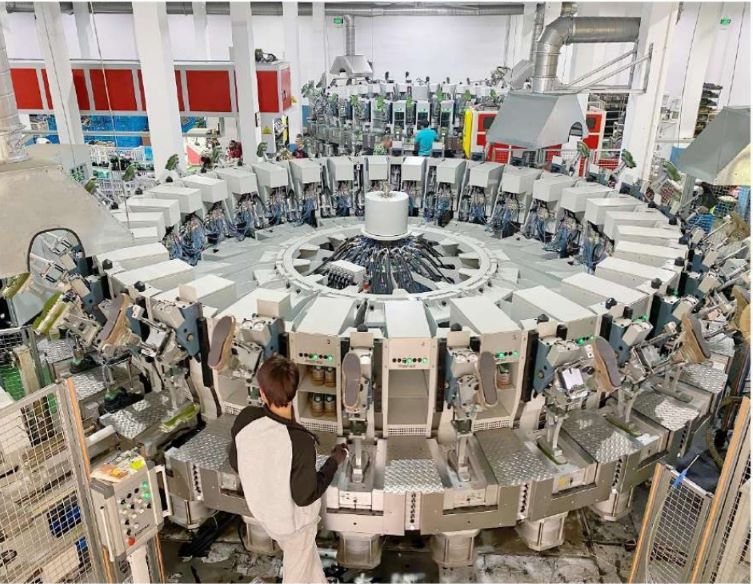
This video offers a closer look at safety footwear manufacturing processes within our production network. Different footwear constructions require different manufacturing controls. Our approach focuses on aligning approved specifications, production processes and quality inspections with the requirements of each project.
Different safety footwear constructions require different process controls.
For injection-moulded footwear, attention may be needed around material handling, moulding conditions, outsole formation, surface appearance and the bond between the upper and sole.
For cemented footwear, material preparation, adhesive application, drying and activation conditions, pressing and assembly consistency can all influence the finished result.
Waterproof footwear introduces additional considerations, particularly around membrane construction, seams, lasting and areas where the water barrier may be affected.
A single inspection checklist cannot fully represent every construction.
Our quality-control approach therefore considers the production process, product specification and risks associated with the individual model.
Depending on the project, monitoring may include:
Pre-production confirmation
First-production or first-piece review
Inline workmanship and component checks
Inspection of critical assembly details
Finished-product appearance and specification checks
Packing and pre-shipment verification
The purpose of these checkpoints is to identify deviations early enough for effective corrective action.
Final inspection remains important. But discovering a systemic problem after an entire order has been produced is already expensive.
This is why production follow-up and process control matter alongside finished-product inspection.
Safety footwear intended for European markets must be developed with the relevant regulatory and product requirements in mind.
For applicable products, the key framework includes Regulation (EU) 2016/425 and standards such as:
EN ISO 20345:2022+A1:2024 — Safety footwear
EN ISO 20347:2022+A1:2024 — Occupational footwear
These standards address different footwear categories and should not be treated as interchangeable.
Workway supports customers with product development and testing coordination aligned with the intended footwear category, protection requirements and target market.
Depending on the project, this can involve:
Reviewing intended protection classifications and additional requirements
Identifying components and constructions relevant to testing
Coordinating product testing with appropriate third-party organisations
Supporting communication concerning technical documentation and certification requirements
Reviewing the potential impact of subsequent material or construction changes
Product testing, EU type-examination, conformity assessment and routine manufacturing QC serve different purposes.
A certificate relates to the product and construction covered by its scope. It should not be interpreted as a blanket approval for every product made by a manufacturer or every future variation.
Responsibilities for conformity assessment, technical documentation, declarations and market placement must also be established according to the relevant legal and commercial arrangements.
For European buyers, one of the most useful questions is not simply whether a supplier has experience with CE certification.
It is whether the supplier understands which changes may affect the product that was originally assessed.
Quality problems are not always found in the footwear itself.
In private-label B2B programs, incorrect labelling or packing information can create significant commercial problems, even when the shoes have been manufactured correctly.
This becomes particularly important when a shipment contains several:
Models and colourways
Size assortments
Customer article numbers
Inner-box designs
Hangtags and barcode versions
Carton markings
Purchase-order references
A correctly produced pair packed under the wrong SKU can still create sorting work, delivery delays or customer claims.
For this reason, relevant packing controls should connect the finished product with its approved labels, artwork, quantity and order information.
Workway supports multi-SKU and customer-specific packaging programs in which specification accuracy matters throughout production and shipment preparation.
For a B2B importer, packaging is not separate from quality. It is part of what has been ordered and must be delivered correctly.
A successful safety footwear model may remain in a customer's range for several years.
During that time, the product rarely remains completely unchanged.
Materials may be discontinued. Suppliers may update specifications. Customers introduce new colours or related styles. Packaging changes. Production adjustments become necessary.
The objective is not to prevent every change.
It is to understand which changes matter.
A change to carton artwork does not present the same technical risk as replacing an outsole compound or penetration-resistant component.
Where a proposed change could affect the approved construction, performance or conformity assessment basis, its impact should be evaluated before implementation.
For long-term programs, maintaining an identifiable history of important product changes helps make repeat orders easier to manage.
It also makes investigations more effective if a quality problem appears later.
A repeat order should not mean repeating the original development process. But it should not mean assuming that nothing has changed, either.
This is one reason we consider repeat-production consistency an important indicator of manufacturing capability.
No realistic manufacturing system can guarantee that quality problems will never occur.
What matters is how problems are investigated and what changes afterwards.
When a complaint is received, a useful corrective-action process considers several questions:
What happened? Establish the actual problem, its scope and the evidence available.
Which products may be affected? Review the relevant batches, materials, production periods or processes where traceability information is available.
What caused the problem? Distinguish the visible defect from its underlying cause.
What action is needed? Determine containment, correction and longer-term preventive measures.
Did the action work? Review whether the measure addresses the cause and whether further follow-up is necessary.
Workway uses structured problem-solving approaches, including 8D reporting where appropriate, to support quality investigations and corrective action.
For example, repeated component failures may require more than replacing defective parts. The attachment design, material specification, assembly process or relevant inspection criteria may also need review.
Likewise, recurring labelling errors may require changes to artwork approval or version control rather than additional finished-shoe inspection.
Resolving one complaint and preventing the same problem from returning are two different responsibilities.
We consider a corrective action most valuable when its findings can be incorporated into future production.
Quality expectations vary between customers and projects.
An established European safety footwear brand may already have detailed specifications, inspection requirements and its own certification arrangements.
Another importer may need more development and documentation support when introducing a new private-label range.
Our role is to understand those requirements and agree how quality-related responsibilities should be managed.
Depending on the project, discussions may cover:
Product specifications and critical component requirements
Development samples and production approval
Target standards and testing arrangements
Material changes and technical evaluation
Inline, final and pre-shipment inspection expectations
Customer-specific packaging and labelling controls
Handling of non-conformities and corrective actions
Repeat orders and ongoing product changes
Where appropriate and available, relevant documentation or quality-control information can be reviewed with customers, subject to confidentiality and project arrangements.
We believe that a quality system should be judged not only by the procedures it describes, but also by how clearly it manages responsibilities and responds when something does not go according to plan.
Routine production inspection, sampling-based verification and laboratory performance testing serve different purposes. The appropriate scope and frequency depend on the product, applicable requirements, identified risks and agreed quality arrangements. Complete laboratory testing of every finished pair is not a normal substitute for controlled manufacturing processes.
Not automatically. The significance of a modification depends on the components, construction, performance characteristics and scope of the original assessment. Changes that could affect compliance need appropriate technical review, including involvement of the relevant notified body where required.
Beyond product workmanship, multi-SKU programs require accurate control of article references, sizes, colourways, labels, packaging and packing quantities. These requirements should be defined and verified at appropriate points before shipment.
For detailed guidance on the broader subject, explore:
Safety Footwear Manufacturing for European Markets — A Practical Manufacturer's Perspective
EN ISO 20345:2022+A1:2024 Explained — A Manufacturer's Perspective on Safety Footwear
Common Safety Footwear Production Issues European Buyers Should Watch
Why Safety Footwear Projects Fail After Sampling — And How European Buyers Can Prevent It
If you are developing a private-label safety footwear range, reviewing an existing supplier or preparing a new OEM/ODM project for European markets, we welcome a discussion about your product specifications, compliance requirements and quality-control priorities.
Share your target market, footwear classification, product concept or current quality concerns. Our team can help review the manufacturing considerations and determine what should be clarified before the project moves forward.
Discuss Your Safety Footwear Project with Workway
 1504, Building B, Taidi Haixi Center, Hai Cang District, Xiamen, 361026, China.
 Jack
 Tel: +86-592-6511408
 Email: info@workwaysafety.com